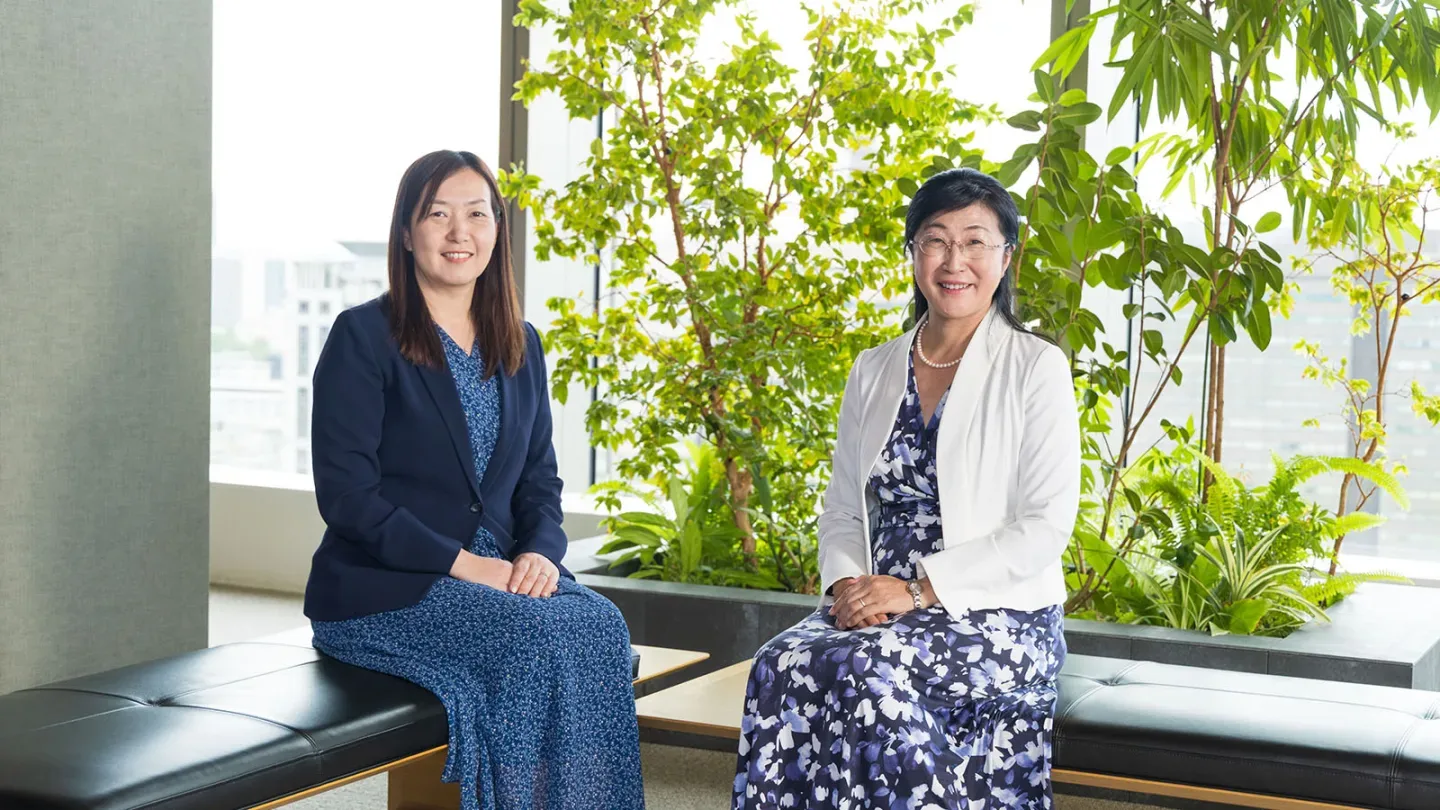
Dialog Between Outside Directors: The Board of Directors That Formulated the Group Growth Strategy—Shinobu Matsui x Junko Seto
In June 2025, Mr. Sawada became the first outside director to be appointed Chairperson of the Board of Directors, while the Company’s outside directors have come to constitute a majority. What changes have you observed in the oversight and effectiveness of the Board of Directors?
Matsui: It has been five years since I became an outside director, and even in the early days of my appointment, I found it quite easy to express my opinions. I have felt that the Board operates in an open manner. That said, even though discussions at the Board meetings were lively, I noticed that few inside directors spoke up, and most of the comments came from outside directors. I believe this was because the Board had been positioned as a place for hearing the opinions of outside directors on the agenda items that the executives had already discussed thoroughly in advance before presenting them. Therefore, before the Group Management Reform in February 2025, most of the agenda items submitted to the Board were those that had already been extensively discussed by the executives and were nearly finalized. As outside directors, we were particularly aware of how this made it difficult to delve into more fundamental issues. It felt as though agenda items were being submitted to the Board not for discussion but simply for approval. I therefore informed the Board that it would be difficult to give an opinion when agenda items are brought to the Board only at the final stage and requested that we would rather have them presented even if they are still only half developed. In this way, we worked to improve the situation. In particular, since Mr. Sawada, an outside director, became Chairperson of the Board, some agenda items have begun to be submitted to the Board before the executives have reached a conclusion. Given the Company’s conscientious corporate culture, there was initially some hesitation about submitting agenda items to the Board under such circumstances. However, the number of cases where both inside and outside directors actively engage in discussion has increased significantly, and I can sense that the effectiveness of the Board has certainly improved.
Seto: I became an outside director of the Company in June 2025, so I have only experienced the Board after these changes took place. Even from my perspective, having worked for many years at foreign-affiliated companies, I remember being surprised at the time of my appointment by how much more active the discussions were at Board meetings than I had expected. As Ms. Matsui mentioned, discussions at Board meetings sometimes begin from differing opinions, and there is no set policy for resolving them. For example, when the Group Growth Strategy, announced in May 2026, was being formulated, the proposal was first submitted to the Board with the executives still holding differing opinions. Those differences were actually what helped reveal the fundamental issues, allowing us to engage in high-quality discussions. At the Company’s Board meetings, both inside and outside directors exchange a wide range of opinions, including those for and against, when discussing important agenda items that can influence the Group’s direction. Even in such Board meetings, Mr. Sawada’s facilitation as Chairperson helps organize the key points, enabling high-quality discussions that lead to effective decision making.
Matsui: When opinions were divided at Board meetings, we would often ask Mr. Kusumi, “What do you want to do?” seeking his views as the Group’s top executive. In this way, the Board fulfills its supervisory function while respecting the views of the top executive officer. Also, since Mr. Sawada assumed the role of Chairperson, an objective perspective has been brought to the content of agenda items and the timing to be submitted to the Board. I feel there is a healthy and productive tension between Mr. Sawada and Mr. Kusumi.